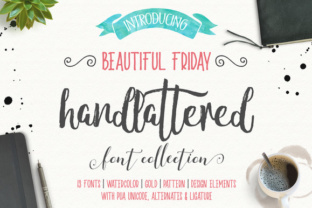
GCM Fonton: A Handwritten Font That Sells Your Craft
As someone who hand-labels small-batch candles, designs printable wedding suites, and cuts vinyl stickers for local boutiques, I know how much a font can quietly shape customer perception. GCM Fonton isn’t just another script font—it’s a warm, confident handwritten typeface by Guillem Castro that lands somewhere between friendly charm and quiet professionalism. It’s got rhythm, personality, and just enough structure to hold up on physical products without sacrificing soul.
GCM Fonton belongs to the Script Amp category—not overly ornate, not too casual. Its strokes flow with natural variation in weight and angle, mimicking real pen-on-paper movement, but it avoids the wobbly unpredictability that makes some handwritten fonts hard to cut or read at small sizes. That balance is why it works so well across my shop: from 0.25-inch sticker labels to 24-inch farmhouse wall signs.
I use GCM Fonton most often for product names and short brand statements—like “Honey Lavender Soy Candle” on a kraft tag, or “Hand-Poured in Asheville” stamped onto a reusable cotton bag. Its lowercase letters have gentle curves and open counters, making it highly legible even when scaled down to 8pt on a 1.5-inch product label. Uppercase letters add subtle flair without overwhelming—perfect for titles on printable planner pages or welcome boards at bridal showers.
For invitations and digital printables, GCM Fonton shines as a primary display font. I pair it with a clean sans serif (like Montserrat or Inter) for body text—keeping the elegance of the script while ensuring guests can actually read the date, time, and RSVP details. On wedding stationery, it gives that handmade, heartfelt tone buyers associate with premium paper goods—without looking like a child’s handwriting or an over-the-top calligraphy piece meant only for monograms.
It’s also become my go-to for seasonal craft projects. Last holiday season, I used GCM Fonton for “Merry & Bright” on ceramic mug decals and “Cozy Nights In” on linen tea towel prints. The font’s consistent x-height and spacing meant no awkward gaps or cramped letters after heat pressing—no re-runs, no wasted inventory. And because it’s designed with practical production in mind, it cuts cleanly on both Cricut and Silhouette machines—even with intricate inner curves like the lowercase a or e.
When designing SVG files for digital download shops, I rely on GCM Fonton’s included OpenType features. It comes with standard ligatures (like fi, fl) and stylistic alternates—small tweaks that let me adjust the look of repeated words across a set of printable quote cards or affirmation posters. These aren’t flashy swashes, but thoughtful refinements: a slightly lifted terminal here, a softer exit stroke there. They add polish without complicating file prep or vector conversion.
File-wise, GCM Fonton ships in OTF and TTF formats—fully compatible with Canva, Adobe Illustrator, Affinity Designer, and Cricut Design Space. No missing glyphs or rendering hiccups on mockup previews. And yes—it supports multilingual Latin-based languages (including accented characters for Spanish, French, and Portuguese), which matters when I design bilingual baby shower invites or market my printables internationally.
Readability tips I’ve learned through trial: avoid using GCM Fonton below 6pt for printed labels unless you’re printing at high resolution (300dpi+). For vinyl stickers under 1 inch, stick to uppercase-only phrases or very short two-word combinations (“Joyful Home”, “Made With Love”). Always outline text before exporting SVGs—especially if sharing templates with customers who may not own the font. And test print a sample label at actual size before running a full batch.
Font pairing is where GCM Fonton really flexes its versatility. As a handwritten font, it pairs beautifully with neutral sans serifs for modern contrast—think GCM Fonton headlines over Lato or Poppins body copy. For rustic or vintage-themed packaging, try it with a soft serif like Playfair Display or Cormorant Garamond. What I avoid? Other script fonts layered underneath or beside it. Too much flourish creates visual noise, especially on small tags or social media graphics.
Commercial licensing is non-negotiable for anyone selling physical products or digital downloads—and GCM Fonton includes a clear, straightforward commercial license. That means I can embed it into Canva templates, include it in SVG bundles for Etsy, use it on t-shirt transfers, or apply it to client-branded packaging—all without worrying about compliance. Just keep your license active and credit Guillem Castro per the terms (a simple “Font by Guillem Castro” in your product description or template readme covers it).
In my shop, fonts aren’t just decoration—they’re part of the product’s voice. GCM Fonton helps me say “carefully made,” “thoughtfully designed,” and “uniquely yours” before a customer even reads a single word. It elevates candle labels into keepsakes, turns printable wall art into heirlooms, and gives wedding signage that effortless, human warmth people pay extra for. It’s not a background player. It’s part of the craft.
If you work with physical goods, digital printables, or client-facing branding—and you need a premium font that bridges expressiveness and execution—GCM Fonton earns its place in your core Fonts folder. Not as a novelty, but as a reliable, readable, commercially ready tool that quietly lifts everything it touches.